
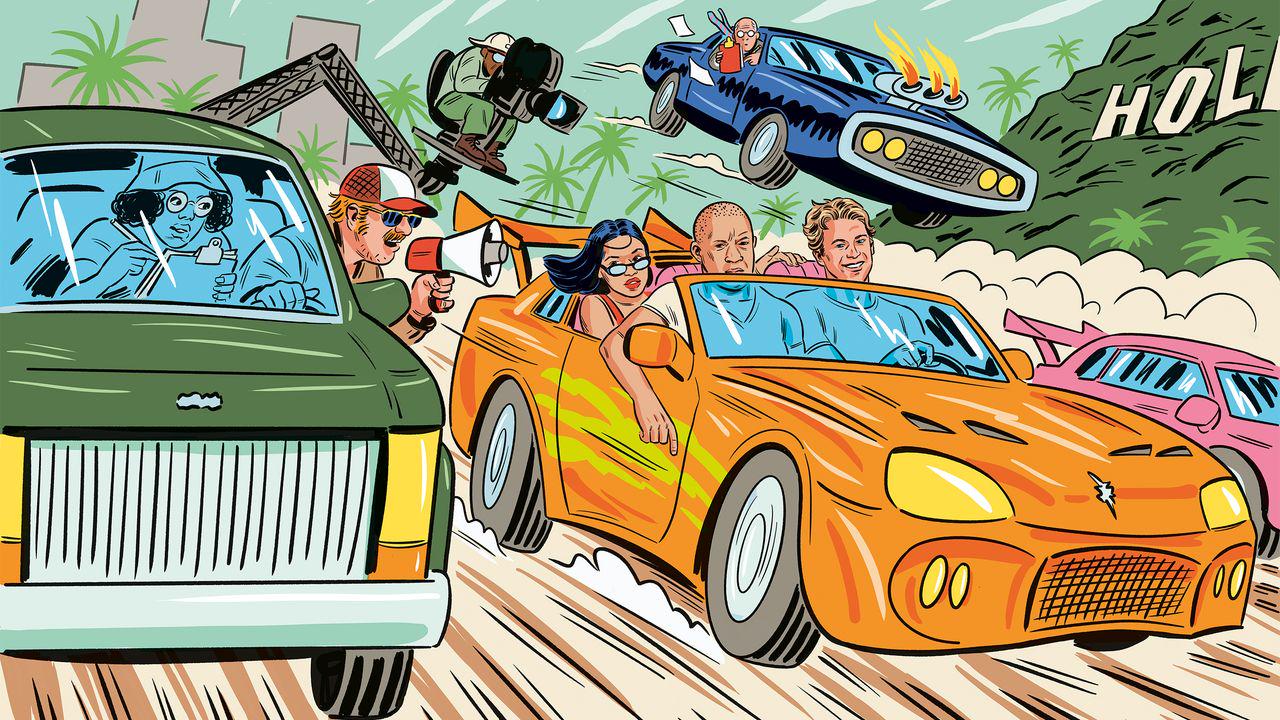
How “The Fast and the Furious” Tells The Evolving Story Of Hollywood – As One Of Universal’s Key Longest-Running Highest-Grossing Franchises Turns 25 Years Old, Its Almost Accidental Success & Lack Of Pre-Existing Lore Shows That The Expensive Films Could Be Mined For As Long As They’re Profitable.
by lowell2017
1 Comment
Full text:
“When “The Fast and the Furious” premièred, on June 18, 2001, few expected it to be particularly successful. The formula was alluring but dumb: a young, hot cop goes undercover in the world of illegal street racing to infiltrate a gang of young, hot robbers. Nowadays, films with box-office appeal are audience-tested within an inch of their lives. But relatively little oversight went into “The Fast and the Furious,” which was just another mid-budget, medium-stakes bet, at a time when studios took more of a kitchen-sink approach. Starring Paul Walker and Vin Diesel, “The Fast and the Furious” ended up being a surprise hit, outearning known entities such as “Lara Croft” and “Dr. Doolittle 2” the week of its release. Made on a relatively modest budget of thirty-eight million dollars, it grossed more than five times that amount.
Twenty-five years and ten features later, “Fast” has become one of the most successful franchises in the history of Hollywood. Several of the films are among the most expensive ever made, and all of them combined have grossed more than seven billion dollars. Our impressively multicultural team of street racers now freelance in the shadowy and complex world of covert ops, jetting around the world to take down an increasingly unhinged array of nihilist supervillains. What holds the series together is a notional commitment to one’s chosen family, with Diesel’s principled-lunk paterfamilias, Dominic Toretto, ready with a cold beer and some big-picture wisdom at the end of a world-saving adventure. “Everyone’s looking for the thrill, but what’s real is family.”
Sometime around the 2011 release of “Fast Five”—the one where two cars drag a five-ton bank vault through the streets of Rio de Janeiro, occasionally using it to smash police cars—the series transcended its identity as a typical blockbuster and came to take on a deeper cultural significance. The film critic Wesley Morris won the 2012 Pulitzer Prize for Criticism, in part, for a much discussed review highlighting the “accidental genius” and progressive feel of “Fast.”
As Morris and others pointed out, the franchise made an early and relatively organic commitment to diverse casting, growing from the core of Diesel, Walker, Jordana Brewster, and Michelle Rodriguez, to include Sung Kang, Tyrese Gibson, and Chris (Ludacris) Bridges, Nathalie Emmanuel, Dwayne Johnson, and Jason Momoa. “When we started,” Rodriguez, who plays Toretto’s wife, Letty, said, at a recent première, “there were no people of color, like, in movies. . . . People saw that the world wasn’t the United States of America and it wasn’t just Caucasian, you know? That the world was very yellow and very brown.” And then there’s the daffy spectacle of the films themselves, with plots beholden to almost avant-garde manipulations of time, space, and reality. We once gasped at cars launching over ravines; now we marvel in dumbfounded delight as cars parachute from cargo planes, or even rocket into outer space.
In a new book, “Fast and Furious Franchising,” the media scholar Dan Hassler-Forest argues that the series is central to understanding the evolution of Hollywood over the past twenty years. At first, it was easy to dismiss these movies, built on “predominantly male characters entering their phallic automobiles in an endless series of epic dick-measuring contests.” Yet Hassler-Forest found himself fascinated with the “surprisingly intricate mythology” of the franchise, “all the more compelling for the fact that it had so obviously been made up as it went along.”
While the Marvel Cinematic Universe is often held up as the exemplar of the I.P.-driven Hollywood mega-franchise, he argues that the “Fast” movies, which started seven years before the M.C.U., have been just as influential. They emerged at a time when the “ideal form” of a franchise was still the trilogy—think about the original “Star Wars” or “Indiana Jones.” Even the most ambitious stories often felt exhausted by the third installment, with diminishing creative and financial returns. The almost accidental success of “The Fast and the Furious,” and its lack of preëxisting lore, suggested an alternative model for franchising: a cinematic universe that could be mined for as long as was profitable. While the films build on a common history, often going to great lengths to retroactively explain away inconsistencies or revive presumed-dead stars, the sequels aren’t bound to a single story.
To enforce some illusion of narrative coherence, “Fast” was early in its use of mid-credits scenes to tease sequels or introduce plot twists. And, during an era in which studios often relied on the long tail of home DVD sales, the series’ producers were inventive in their use of bonus features, commissioning short films, like “Los Bandoleros,” which currently stands as one of Vin Diesel’s last directorial efforts, to shade in backstories. The films became a kind of self-justifying expansion of brand identity, writing their own elaborate, globe-trotting canon as they went along.
The initial success of the “Fast” movies made sense within the aggro culture of early-two-thousands America, a kind of “Ocean’s 11” for dudes in muscle tees, but it wouldn’t have survived on this demographic alone. The franchise seemed to be losing steam by the third film, “The Fast and the Furious: Tokyo Drift,” from 2006, which is possibly the best stand-alone movie in the series, but failed as an attempt to continue the franchise without Walker and Diesel. While “Tokyo Drift” didn’t make as much money as Universal had hoped, it did earn more abroad than domestically. Perhaps it’s obvious in hindsight that “fast cars” and “hot chicks”—“Tokyo Drift” director Justin Lin’s summation of the films’ core associations—had international appeal. From the mid-two-thousands on, “Fast” gradually went global, anticipating a turn toward the “vulgar cosmopolitanism” that defines contemporary Hollywood, where any movie with blockbuster aspirations must concoct some reason for the characters to divert through South America or Asia.”