
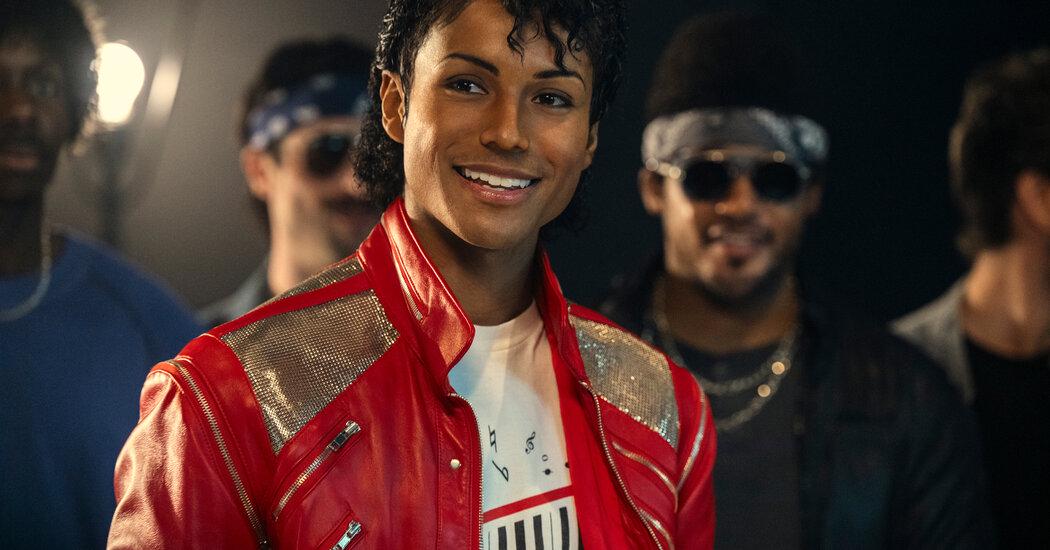
Universal Paid About $75M For “Michael”’s International Distribution Rights Except For Japan, Where Kino Shelled Out A Hefty Sum. It’s Estimated Lionsgate Needs “Michael” To Gross Just $150M Domestically To Generate Substantial Profit. Roughly 30% Of The Cut Material Could Be Used For Sequel Film.
by lowell2017
2 Comments
Full text:
““Let’s celebrate an icon!”
So read the invitation for the Los Angeles premiere of “Michael,” a film about Michael Jackson’s life up to 1988 — before the first child molestation accusations surfaced. Many of the 3,000 attendees (including Jackson’s family) were happy to oblige. They turned up at the Monday event in fedoras and sequins, and sang along to “Billie Jean” and “Bad.” During several scenes, the cheering inside the theater was so loud that it drowned out the film’s dialogue.
It was a perfectly executed marketing moment, but moviegoers will have the final word. Are they ready to celebrate Jackson, too?
Reviews have been brutal. (“Can’t be taken seriously.” “Disconnected from reality.” “Frustratingly shallow.”) Yet box office expectations are stratospheric. The film, which arrives in theaters on Thursday night, comes from the producer behind “Bohemian Rhapsody,” the Queen biopic that collected $911 million worldwide in 2018, or roughly $1.2 billion after adjusting for inflation.
Here’s what you need to know.
A-list film artists worked on it.
At Monday’s premiere, the lead producer Graham King dated the project to 2019. He had just delivered “Bohemian Rhapsody,” and its success sent a torrent of other biopic opportunities his way. He decided to tackle Jackson in cooperation with the estate. (Jackson died at age 50 in 2009 of acute propofol intoxication.)
King, who won an Oscar in 2007 for producing “The Departed,” knew studios would be reluctant. Jackson remained a huge star, but he was also radioactive, in part because of “Leaving Neverland,” the 2019 HBO documentary in which two men recounted what they said was years of sexual abuse by Jackson when they were boys. (The Jackson estate called the men liars and sued HBO, resulting in the removal of the documentary from HBO’s streaming service.)
So King lined up a director and screenwriter for “Michael” that studios would have no choice but to take seriously: Antoine Fuqua, the filmmaker known for “Training Day” (2001), and John Logan, an Oscar-nominated writer whose credits include “The Aviator” (2004) and “Gladiator” (2000). Colman Domingo, a two-time Oscar nominee (“Sing Sing,” “Rustin”), agreed to play Joe Jackson, the abusive family patriarch.
The original script grappled with sex abuse claims.
“Michael” was never going to be a warts-and-all look at the superstar — not with lawyers for his estate riding shotgun. But the version of the project that was shopped to studios depicted a police investigation into child molestation claims. The movie’s third act hinged on accusations by a 13-year-old boy named Jordan Chandler; Jackson agreed to pay him roughly $23 million in 1994 to settle a lawsuit, effectively ending a criminal investigation. (Jackson always denied any wrongdoing.)
Janet Jackson wanted nothing to do with it.
King asked Jackson’s surviving siblings (Tito died in 2024) for permission to depict them in the film. There was one important holdout: Janet Jackson. Her reasons are unknown, and a spokeswoman did not respond to a request for comment.
The film’s solution? It’s as if she never existed. Not so much as a passing mention.
“I wish everybody was in the movie,” Michael’s sister La Toya Jackson told Variety at the premiere. “She kindly declined so you have to respect her wishes.” La Toya is depicted throughout the movie; she also received an executive producer credit.
Jackson’s sons, Prince and Bigi (formerly known as Blanket), have supported “Michael.” His daughter, Paris, has not. In an Instagram video posted in September, she said her notes on what she considered “dishonest” about an early script were rejected. “A big section of the film panders to a very specific section of my dad’s fandom that still lives in the fantasy,” she said in the video.
Hollywood’s biggest studios passed.
In quick order, studio executives showed King the door. “Michael” was too risky, they said, even with the standout creative team.
But a small studio, Lionsgate, was intrigued. “Michael” could be the kind of film that makes Hollywood insiders cringe and mainstream audiences cheer — a subject the cultural elite finds toxic but that rank-and-file moviegoers, given the chance, would turn into a hit. Maybe other studios were underestimating the emotional response that older moviegoers would have in remembering Jackson’s early albums. Maybe the right marketing message — a young man with a dream — could hook teenagers.”
How things have changed. From a guaranteed billion to
“Actually, it only needs to somehow make $150m despite the budget costing more than that!”
But when these articles come out for a sci-fi or comic book movie, they’re fighting for their lives to report it will lose money one way or another.