
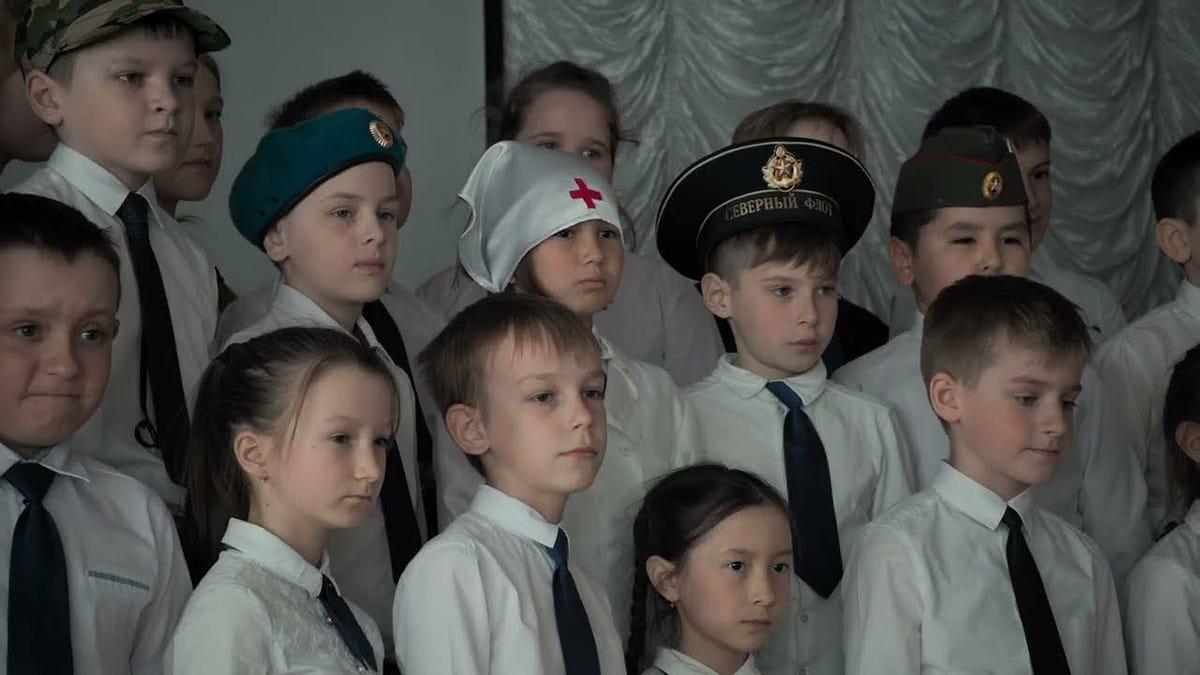
A documentary about how Russian schools become ideological barracks and how ordinary people help turn childhood into raw material for war.
“Commanders don’t win wars. It begins with teachers.” – Vladimir Putin
Russia’s war against Ukraine does not begin with drones.
It begins with assemblies, patriotic lessons, staged ceremonies, obedient staff, frightened adults, and children taught to confuse militarism with virtue.
It begins with early childhood indoctrination.
That is what makes the story told by Mr. Nobody Against Putin so devastating.
As someone born in Russia, raised in the shadow of that culture for 12 years, and shaped by the fact that my mother chose to leave and take me with her to United States while my father chose to stay in Russia and conform, I recognized the atmosphere immediately.
I recognized the moral suffocation.
I recognized the perpetual unfounded guilt trip.
I recognized that texture of life inside a society that teaches people to live in lies and call that realism.
This documentary shows both truths at once: the pressure of the system and the reality that conscience is still possible inside it.
And that second truth is exactly why the first one cannot be treated as an excuse.
by ilya0x
6 Comments
Someone on Tumblr pointed out that there’s a still frame from the Muppets movie in that documentary depicting a Gulag, and Kermit is front and center.
Can’t wait to watch it myself and see whether the Oscar winning documentary plagiarized the Muppets movie. Wasn’t planning on watching it before seeing that post, so if it’s fake I’ll have been tricked into watching a good movie for a Muppet reference and if it’s not fake I can have a fun fact about how an Oscar winning documentary plagiarized a shot from the Muppets. That’s a win-win.
Sadly, that happens in every country. Every school system of every country is an indoctrination system to make the children “patriotic” to their country. Even Canada, US, England. And let’s not get started on why First Nations children were forced to go into “normal” Canadian schools.
Every time that the schools will be directly dependent on governmental fundings and overseeing, like it currently is in *all* countries, the children will be victim to governmental-vindicated indoctrination.
Our own hypocrisy is to believe it happens *only* in Russia or China.
Yes, it’s true Fascists fear teachers because critical thinking empowers.
https://www.goodreads.com/book/show/222683898-why-fascists-fear-teachers?ac=1&from_search=true&qid=E3yC8TPwNL&rank=1
Karabash is a town of about 10,000 people in a country of 143 million. Using it to predict Russia’s future is like using Celina, Texas to explain everything about the United States. It just doesn’t work that way.
My two-year-old actually attended a Russian school for a few months, about 13 hours away from Karabash in a city roughly twenty times larger. It was rock’n’roll in the best way. The teachers went above and beyond and gave him a foundation that, honestly, many U.S. schools struggle to match.
I really should’ve documented it. 😄
There is good documentary about this too that is free on DW Youtube chanel **”**Inside Rural Russia: When Military and Patriotism Are Your Life” [https://www.youtube.com/watch?v=AyOAb7wxl3c](https://www.youtube.com/watch?v=AyOAb7wxl3c)
Dima Zicer, a Russian dissident educator/teacher and writer, speech at Free Russia Forum in Vilnius:
“Does what’s happening now with Russian children and teenagers, with Russian education, gives us any hope that someday those who are growing up in this system will take on a different, more modern, more humane form?
Short answer: no. Just no.
Here’s the longer answer. You know, friends, we’re used to not thinking about education and what’s happening with children. First, they’re small, and we have so many other worries and so much to talk about. Second, we don’t want to think about it.
Any education system is tested like this: you have to look ten years ahead. You look at the 1990s to understand the 1980s. You look at the early 2000s to understand the early 1990s. So we’re not very focused on this. Don’t take it personally. I’m not talking about anyone specific. But broadly, that’s how it is.
And yet, with horror and sadness, I have to say: Putin has brilliant advisers in the field of education. You have to understand that. Our well-meaning comfort, the idea that ‘they’re idiots,’ or ‘teenagers will tell them to go to hell,’ or ‘kids are small, we’ll re-forge them later’ – none of that is going to happen. It doesn’t work like that. Not at all.
I’ll admit: I’m guilty too. Three, maybe three and a half years ago, when people asked me what was happening in education, I also tried to reassure myself. I said: ‘It’s mostly local initiative. The people on the ground are just trying to run ahead of the train. “Important Conversations” lessons are introduced in some places, not in others.’ That’s what it looked like then.
And then I realized what a monstrous mistake I myself had made. Because if you look at what’s happened over the last three and a half years – I count from September 2022 – the nets have been set everywhere. Almost any young person on the territory of the Russian Federation has essentially no chance to break out.
Suppose “Important Conversations” is still optional somewhere. Fine, his mother gets him excused somehow. Then welcome to “family studies,” designed by Golikova and Putin, where they teach children how to ‘love properly’ – I won’t even unpack what that means. Suppose he ‘gets sick’ every week on family studies. Then welcome to extracurricular work weaving camouflage nets. Avoid that too? Then welcome to pre-conscription military training. And so on, and so on, all the way to what you know: bringing killers and criminals – so-called “SVO [Special Military Operation] veterans” – into schools.
And we have to understand how scarry and immoral this is. Society has a basic consensus, right? We don’t corrupt children. We don’t destroy children – at least at the level of a consensus. We don’t bring murderers to children. That line has been crossed. Crossed deliberately, and crossed loudly, in public.
Those nets are everywhere. And these brilliant – criminal – advisers whisper to Putin: ‘Start from the tender age.’
We laugh, we mock them: ‘Look at these idiots, they’re already going into kindergartens.’ But the point isn’t just that they introduce “patriotic lessons.” The point is how personality is formed.
Until about age seven, a child cannot doubt the goodness of adults. First of all parents, but adults in general: adults cannot want us harm. And the most evil thing in the world is exploiting that childlike trait.
If my beloved mother holds my hand and brings me to kindergarten – mother is a goddess in a child’s eyes – and hands me to a caregiver, then of course she means something good. That caregiver becomes one of the most important people in my life. It doesn’t even occur to a five-year-old boy or girl to say: ‘I don’t agree.’
So all that thinking – ‘It’s fine, she’ll go to kindergarten, we’ll fix it at home, we think differently’ – no. The answer is completely no.
And that’s why I began with “no.” Because this is an extremely well-researched topic. I often refer to a major academic study, completed around 1990, about the impact of indoctrination on children in Nazi Germany. And it found roughly this: those who fell into indoctrination before age seven often could not get out of it for the rest of their lives.
In the early 1980s, when Germany began serious surveys about rejecting Nazism, awareness, repentance – many of those people still said things like: ‘Yes, but you can’t deny Hitler was an effective manager.’ It’s terrifying, but that’s how it worked.
So what I want to say is: we have to clearly understand what we are dealing with. I’m not being hysterical. I’m constantly in touch with people there [in Russia] – children, parents, research. This is how it works.
When we engage with someone, we all have different experiences. But we must understand: there’s a very high probability we’re dealing with people who have been infected.
And here’s the question I don’t have an answer to. I’m a practical educator. I like to end every lecture with: ‘Okay, what do we do, step 1, 2, 3?’
Friends, in this case I don’t know what we do. I don’t know at all.
I’ll give a couple of examples. This indoctrination field works even stronger than we imagine. I have a weekly program where people call from all over the world – sometimes from Russia too. About a year ago, a woman called me in tears from St. Petersburg.
Her nephew went into first grade. The family was anti-Putin, a wonderful family, she said. Everything seemed fine. She warned her sister, the boy’s mother: ‘Don’t do it. Don’t go to a state school. Do home education.’ The sister said: ‘No, it’s a great school. We went to it! I know the teacher. We’ll be fine. At home we tell the truth.’
And by around April, the boy started coming home talking about “Banderites,” about being surrounded by enemies, about everyone wanting to destroy us. And when his mother and aunt tried to say, ‘Wait, we think differently,’ he answered: ‘You don’t understand what you’re saying.’ And basically, in simple prison slang: ‘I’ll report you.’
Seven years old. A good family. Cultural capital, St. Petersburg.
I won’t overwhelm you with examples. You can’t even imagine how many there are.
But so we don’t collapse into total pessimism, I’ll say one thing about Ukraine. Guess the most common question Ukrainian parents ask me. You’d think it’s ‘When will this end?’ No.
The question Ukrainian parents ask is: how do we protect children from hatred?
In this nightmare, in this horror, amid the killings organized by Putin and his clique, the main question Ukrainian parents ask is not “when will this end,” not how to prevent a boy to swear loyalty to Putin, but how to protect children from hatred.
And I don’t know what to do with this gap. It shocks me. This isn’t about genes, or people being born different. It’s about reality, which we all still have to fully understand.
How do we protect children from hatred in Russia, when they are being put on hatred like an addiction? I think that’s one of our main questions.”